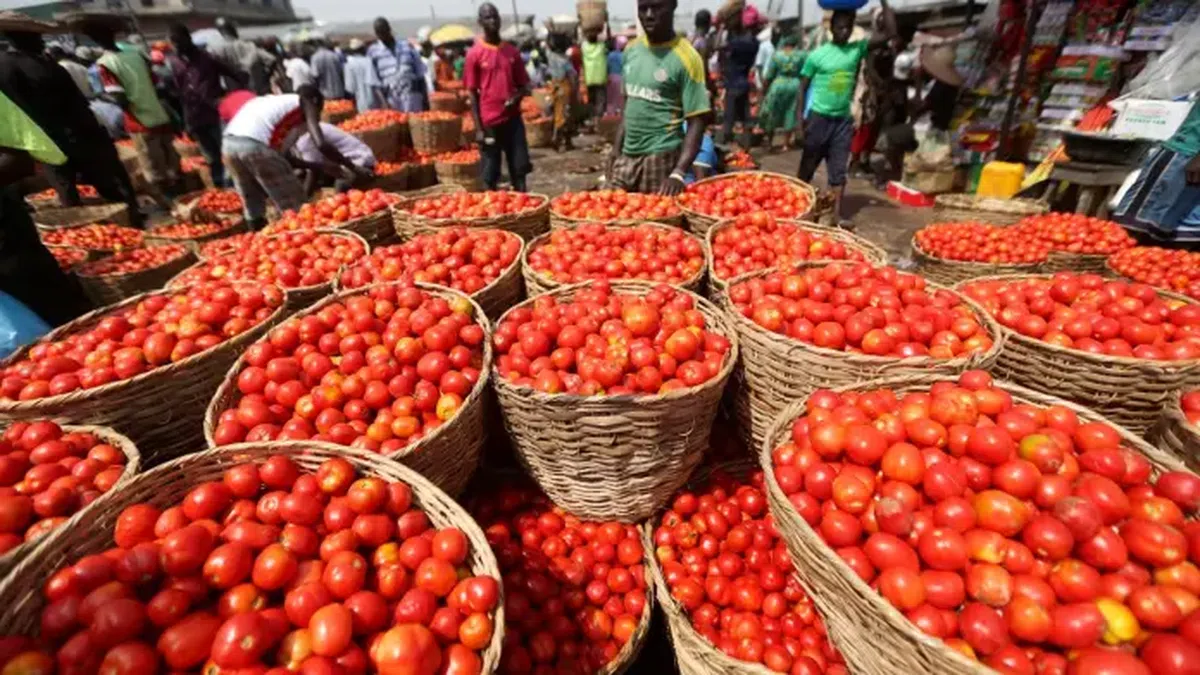
The director of protocol at the Ministry of Food and Agriculture, Justice Quarm, has stated that the embargo placed on tomato imports from Burkina Faso will impact Ghana significantly.
Quarm stated during an interview on Adom FM’s Dwaso Nsem that Ghana has had situations in the past.
Quarm also stated that the previous restrictions were between November 2020 and December 2020; following a series of political events in Burkina Faso, the authorities in Burkina Faso imposed a restriction on tomato exports, causing prices to rise dramatically in Ghana.
Quarm stated that the Ministry collaborated with farmers’ associations to develop sustainable, long-term solutions to the challenges that existed when the National Democratic Congress’ government came to power.
He also referenced many of the challenges facing farmers, such as inadequate irrigation infrastructure and lack of financing, as well as utility and limited machinery available to farmers.
Therefore, the Ministry of Food and Agriculture supported these farmers by working with them to increase local production. This approach resulted in local farmers growing more tomatoes, which ultimately created a surplus of tomatoes and, therefore, provided the government with a reason to purchase and store extra tomatoes.
However, Quarm stated that locally-grown tomato varieties also caused local constraints with respect to quality/demand.
In response to this, he noted that the current government has fostered the growth of cooperatives to foster large-scale agricultural production and has laid the foundation for a tomato processing facility. Furthermore, he also commented that although the current measures do exist, it is the fact that many of the long-term solutions still have not been put into place.
“The current ban is going to severely impact Ghanaians because the measures that have been set out by the Ministry/ and government have yet to fully manifest into tangible production of Ghanaian tomatoes,” he said.
In addition, he mentioned that the government is also supporting the construction of a farm services center in Afram Plains so that farmers can access better tomato and vegetable seedling varieties.
About the Author