Mustapha Ussif, a former Minister for Youth and Sports, has denied any involvement in the irregularities mentioned in the recently published audit report on the 13th African Games, claiming that he shouldn’t be held accountable for any of the report’s errors.
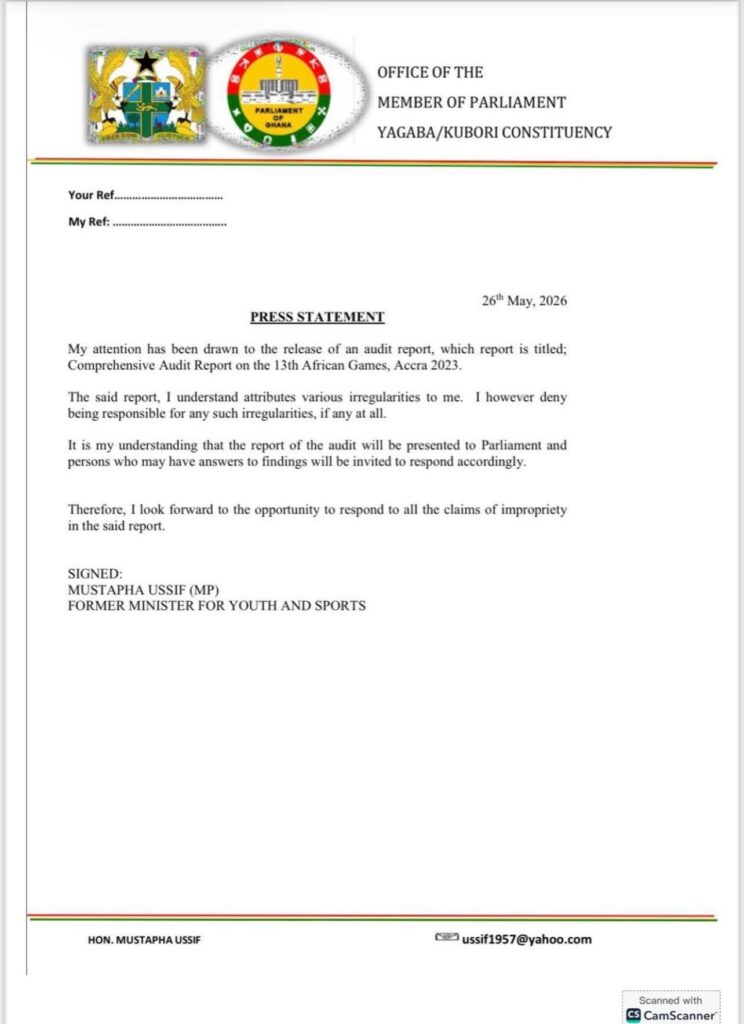
Ussif stated in a statement issued after extensive public discussion of the report that his attention had been drawn to the publication titled “Comprehensive Audit Report on 13th African Games, Accra 2023,” which apparently mentioned him in a number of discoveries concerning procurement, contract management, and financial anomalies.
“I hear that the aforementioned report blames me for a number of irregularities,” the former minister said.
“I, on the other hand, refute being accountable for any such irregularities, if there are any at all,” he continued.
Sanctions and recovery operations against a number of former officials, including Ussif, former Chief Director William Kartey, and former Local Organizing Committee Chairman Dr. Kwaku Ofosu-Asare, were advised in the audit report due to procurement violations and financial infractions related to Ghana’s 2024 Games hosting.
Before any conclusions are made, Ussif claims that he is waiting for the chance to formally react to the discoveries.
“It is my understanding that the report will be presented to Parliament, and people who may have answers to findings will be invited to respond appropriately,” he stated.
The ex-minister emphasized that the parliamentary system would offer the required forum for clarity and responsibility.
“As a result, I’m excited about the chance to refute each allegation of impropriety made in the aforementioned report,” Ussif remarked.
The audit report, which has sparked heated controversy regarding the governance, procurement compliance, and financial accountability of the continental sports event held in Ghana in 2024, has been the subject of his reaction, which is the first public response from any of the main authorities mentioned in it.
The report describes several purported anomalies with procurement procedures, contract inflation, unexplained expenses, and inadequate administrative controls, and it suggests sanctions under the Public Procurement Act and the recovery of hundreds of millions of cedis.
About the Author