

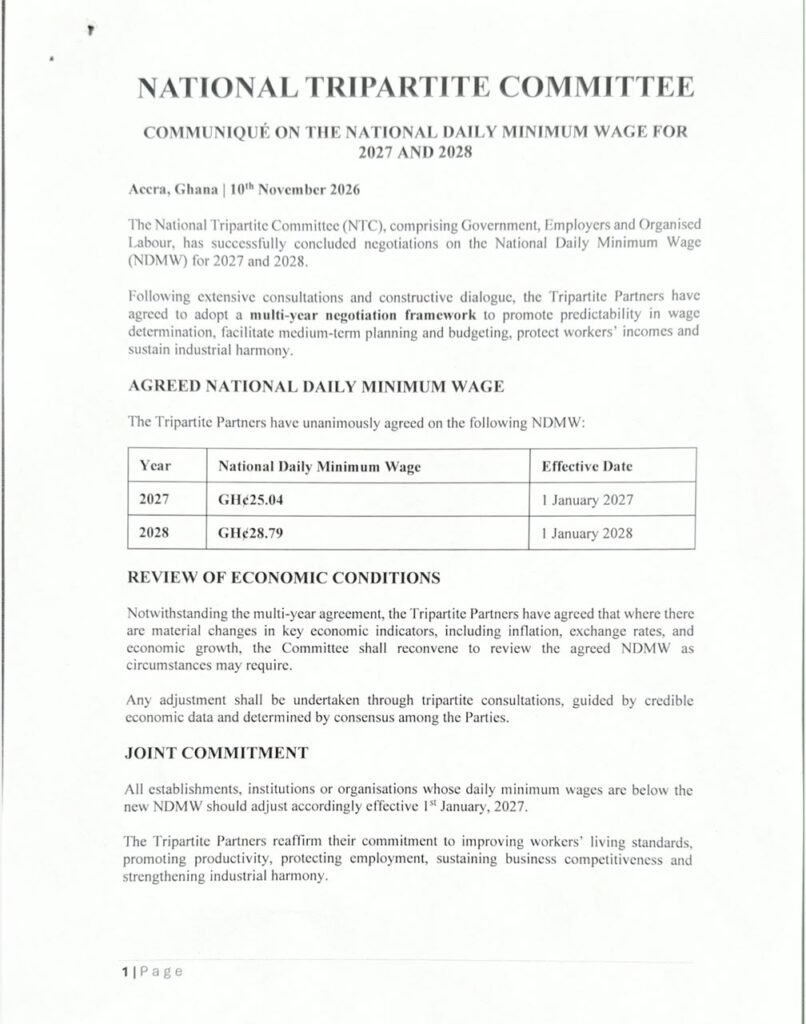
Following discussions between the government, employers, and organized labor, the National Tripartite Committee (NTC) has decided to raise Ghana’s National Daily Minimum Wage (NDMW) to GH¢25.04 for 2027 and GH¢28.79 for 2028.
According to a communiqué issued on November 10, 2026, the Committee stated that the deal was reached after thorough discussions and productive talks among the three partners.
On January 1, 2027, the new minimum wage of GH¢25.04 will be implemented, and on January 1, 2028, the rate of GH¢28.79 will be implemented.
According to the Committee, the decision to use a multi-year negotiation framework was made to encourage predictability in wage determination, make medium-term planning and budgeting easier, safeguard workers’ incomes, and maintain industrial peace.

The Committee has stated that it may meet again to examine the agreed prices if there are significant changes in important economic factors such as inflation, exchange rates, and economic growth, even though the agreement is for two years.
It stated that any modifications would be made via trilateral discussions, based on reputable economic statistics, and agreed upon by all parties.
Additionally, effective January 1, 2027, the Committee has instructed all businesses, organizations, and institutions whose daily minimum salaries are less than the revised rate to make the necessary adjustments.
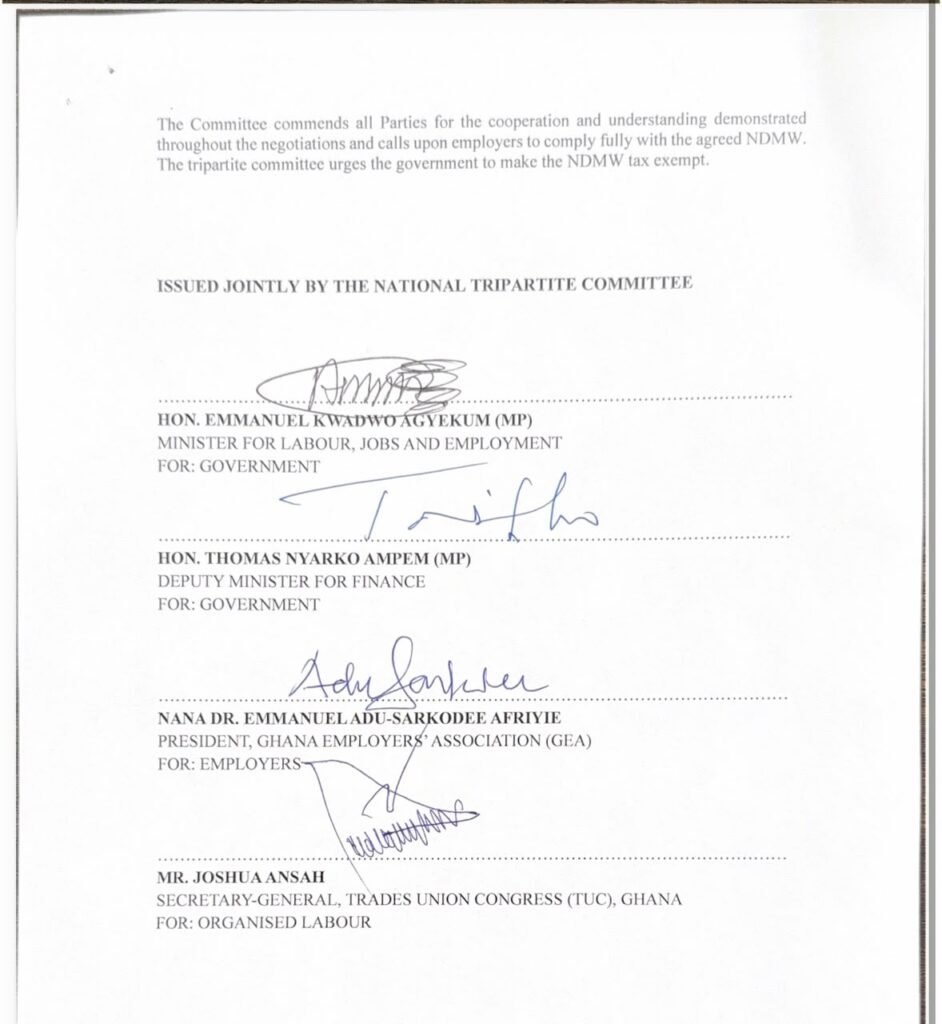
Moreover, it urged employers to strictly adhere to the agreed upon minimum wage and requested the government to make the National Daily Minimum Wage tax-free.
The Minister for Labour, Jobs and Employment, Emmanuel Kwadwo Agyekum, the Deputy Minister for Finance, Thomas Nyarko Ampem, the President of the Ghana Employers’ Association, Nana Dr. Emmanuel Adu-Sarkodee Afrifie, and the Secretary-General of the Trades Union Congress (TUC), Joshua Ansah, signed the agreement, which was issued jointly by the National Tripartite Committee.
The Committee reiterated the government’s, employers’, and organized labor’s commitment to enhancing employees’ living conditions, fostering productivity, defending employment, preserving business competitiveness, and bolstering industrial harmony.
About the Author